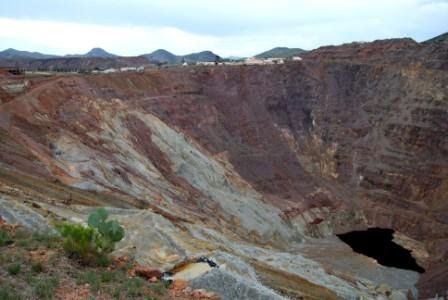
“Mining is the extraction of valuable minerals or other geological materials from the earth, from an ore body, vein or (coal) seam. The term also includes the removal of soil. Materials recovered by mining include base metals, precious metals, iron, uranium, coal, diamonds, limestone, oil shale, rock salt and potash. Any material that cannot be grown through agricultural processes, or created artificially in a laboratory or factory, is usually mined. Mining in a wider sense comprises extraction of any non-renewable resource (e.g., petroleum, natural gas, or even water).” Wikipedia online.


“The mining industry plays a critical role not only in our state and nation, but also in the world.” “If it can’t be grown, it must be mined.” Arizona Mining Association


Fast Facts About Minerals
Source: National Mining Association
U.S. Demand
- Every American uses an average of 43,000 pounds of newly mined materials each year.
- Telephones are made from as many as 42 different minerals, including aluminum, beryllium, coal, copper, gold, iron, limestone, silica, silver, talc and wollastonite. Without boron, copper, gold and quartz, your digital alarm clock would not work.
- A television requires 35 different minerals, and more than 30 minerals are needed to make a computer.
- The construction industry accounts for approximately 51 percent of US copper demand.
- Silver's largest market use is for industrial applications, particularly as an electrical connector. Jewelry is the second largest use of silver.
- The Toyota Prius plug-in-hybrid requires about 50 pounds of rare earth metals for its motor and battery.

U.S. Mineral Production
- The United States produced about 7 percent of the world's nonfuel nonferrous minerals in 2008.
- Processed materials of mineral origin account for about 4 percent of U.S. gross domestic product.
- The United States is the world's second-largest producer of gold, which in addition to jewelry, is used to make computer circuitry.
- America's copper mines rank second only to Chile in production.
- The United States is the world's leading producer of beryllium, soda ash, molybdenum, sodium sulfate and sulphur.

U.S. Minerals Mining Employment
- The National Mining Association estimates that in the next 5-10 years, the mining industry will need approximately 55,000 new miners across the U.S. to meet demand and to replace retiring mine employees. In addition, according to the Society for Mining Metallurgy & Exploration, at least 300 new mining and minerals engineering graduates are needed annually to keep up with projected growth.
- Nearly 400,000 people work directly in mining throughout the United States. Employment in industries that support mining, including manufacturing, engineer, environmental and geological consultants, accounts for nearly 1.5 million jobs.
- The average miner makes $72,000 per year in salary, not including overtime, bonuses and benefits.
- U.S. metal/nonmetal miners report 3.7 non-fatal injuries per 100 workers in 2007, a lower rate of occupational injuries than agriculture, forestry & fishing, construction, manufacturing, transportation, and wholesale & retail trade.

U.S. Minerals Mining Economic Impact
- In 2007, the mining industry paid approximately $21.6 billion in taxes, royalties and fees to federal, state and local governments combined. Nearly $64.6 billion was paid to mining industry employees in direct and indirect wages and benefits.
- The total direct and indirect impact of U.S. mining is valued at $1.9 trillion - mining produced $98.4 billion of finished mineral, metal and fuel products that were then transformed by consumer industries into goods creating an additional $1.8 trillion in value added.
- According to U.S. Geological Survey analysis, the value added to U.S. GDP by major industries that consume processed mineral materials was an estimated $2.3 trillion in 2008, 16 percent of U.S. GDP.
- Minerals and materials processed from minerals account for exports worth as much as $102 billion per year (USGS).

U.S. Minerals and the Environment
- Mining has touched less than one-half of one percent of all the land in the United States.
- Only 3 million acres of public land have gone into private ownership from mining, while 94 million acres have been granted to railroads and 288 million acres privatized as agricultural homesteads (BLM).
- Since 1978, more than 2.6 million acres of mined lands have been restored to their original or better condition, as well as more than 285,000 acres of coal mines abandoned long ago.

U.S. Minerals Mining Contributes Significantly to the American Economy
• U.S. minerals mining contributes more than $13.6 billion in personal income and payroll taxes annually.
• The total value of U.S. minerals mining output is valued at more than $68 billion.
• U.S. minerals mining employs or supports 650,000 high wage jobs, paying more than $40 billion in wages and salaries.

U.S. Minerals Mining is Environmentally Responsible
• The industry is among the most heavily regulated in the world, complying with scores of federal and state laws, including: the Clean Water Act, Clean Air Act, Endangered Species Act, Resources Conservation and Recovery Act, the National Environmental Policy Act and the Antiquities Act among others, as well as with specific regulations governing mining administered by multiple federal agencies.
• Since 1980, the minerals mining industry has reclaimed nearly 200,000 acres of mined lands.
• A 1999 study by the National Research Council of the National Academy of Sciences concluded the existing regulatory framework for mineral mining was effectively protecting the environment.
Source: National Mining Association

I have been known to be a bit on the opinionated side. I might be more so on the subject of mining. I will just blame it for growing up in Arizona. Seems to me that it makes sense to have safe and successful businesses. Mining would be one of those. The only people I can see being able to argue the need for mining would be a select few. They would have to live in cave, have no modern conveniences, and be completely off the grid. Guess their clothes would be hand made of leaves, fur, or home spun cotton. And none of them would have a computer or smart phone. No chance any of those folks would be reading this, so I am safe here.
Of course there are always the NIMBY folks, “Not in My Back Yard!”, but that is for another blog.

Knowledge is power. Use the links provided to get more information and knowledge.